Teaching
Global Self-Produced Territories (Excerpt)
Since 2008
Authors:
Ignacio Cardona, Associate Professor
Institutions:
Harvard Graduate School of Design; Universidad Simón Bolívar; ; Wentworth Institute of Technology; University of Toronto; other academic institutions
*
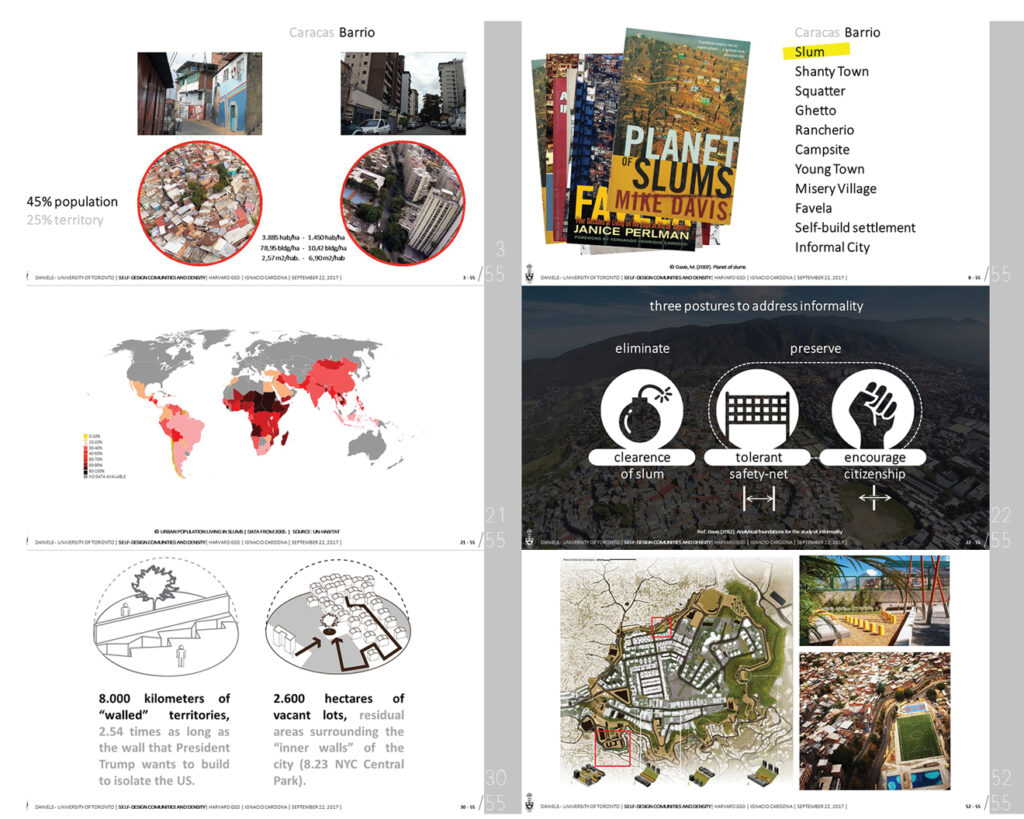
Developed through lectures, workshops, and academic consultations since 2008, this teaching material examines self-produced territories as a global urban condition. It begins by connecting urban fragmentation and spatial inequality to processes of socioeconomic segregation, questioning the conventional use of informality as a category for defining underserved territories and introducing self-production as an alternative conceptual framework.
The material then frames a central debate: whether self-produced environments should be eliminated, tolerated, or supported as legitimate processes of city-making. Through comparative cases and theoretical perspectives, the lectures examine how land policies and urban design can engage these territories, emphasizing spatial strategies that reconnect segregated communities, reduce urban inequalities, and recognize residents as active producers of the city.
This evolving body of teaching and research ultimately informed my doctoral thesis at the Harvard GSD, where these questions were further developed through the concept of Spatial Opportunity