Research
Rethinking Indicators of Urban Self-Production
2019
Authors:
Ignacio Cardona, Researcher
Advisors:
Anita Berrizbeitia, Diane Davis, Rahul Mehrotra
Institutions:
Harvard Graduate School of Design
*
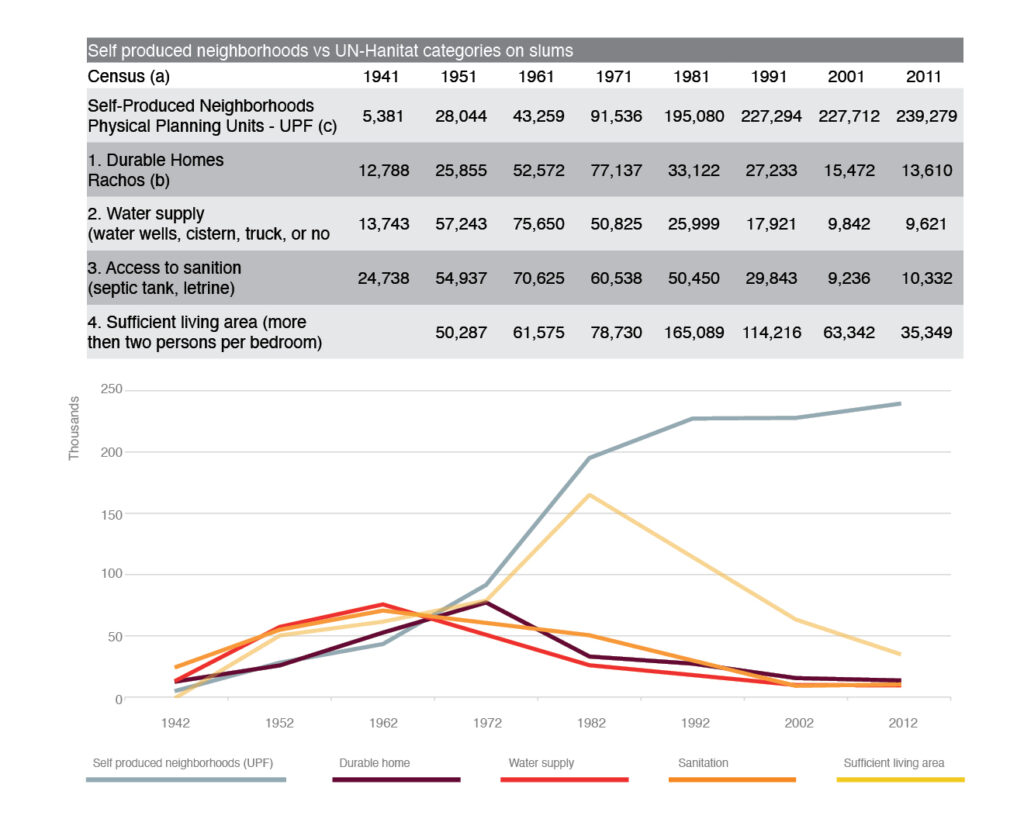
Developed as part of the doctoral research Spatial Opportunities for Self-Produced Environments, this study questions whether conventional housing indicators are sufficient to understand self-produced urbanization. It examines UN-Habitat’s four components for defining slum conditions—housing durability, access to water, sanitation, and sufficient living area—and argues for indicators that also evaluate access to serviced land and the broader urban systems supporting everyday life.
Using census data from Caracas between 1942 and 2015, the research compares improvements in household services with the historical expansion of self-produced settlements identified in official plans. The findings reveal that housing conditions progressively improved while the number of dwellings classified within self-produced settlements continued to increase, demonstrating the limitations of housing-based indicators alone for understanding spatial inequality.